- English Tenses Chart
- Chart Of English Tenses In Hindi
- Chart Of Tenses In English Grammar With Examples
If you are a beginner in tenses. You are searching where I can learn all the tenses. Here I have provided a basic tense chart.
It helps to remember all the rules and formulas easily. you can be saved this chart offline to learn in your spare time.
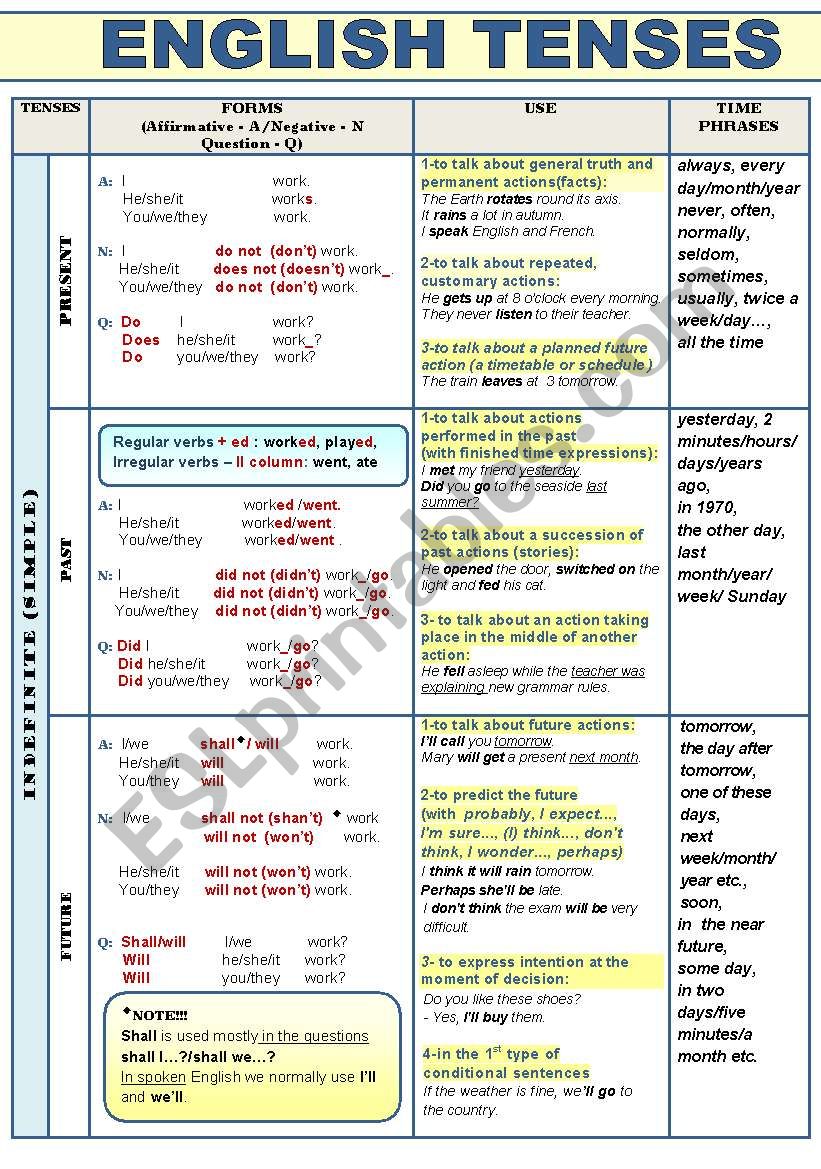
The table below shows a chart of tenses in English.
Tense Chart Rules & Examples
English Tenses Chart
All TENSE CHART. Let’s start this beautiful post on the tense chart Definition of Tesnes – Tense is used to show the time at which the action of a verb takes place. In all languages, tense is divided into three classes namely – 1. Present Tense 2. Each of these tenses is further divided into four classes. Chart of tenses examples sentences. Grammar Sikhane ke Liye Aapko irregular verbs (IrregularVerbs.xyz) Website ka bahut jaruri hai. Yaha Par Regular and Irregula Verbs Listed hai Check Kare aapko Yah Website Bahut Pasand Aayega. – irregular verbs chart of tenses with rules and examples. Visual aids for all major tenses in English, including an example sentence and a quick conjugation and grammar explanation. 1) SIMPLE TENSES Simple Present Tense It snows in Alaska. I watch television everyday. I visit my cousin all the time. In general, the simple present expresses events or situations that exist always, usually, habitually; they exist now, they have existed in the past, and will probably exist in the future.
12 Basic form of Tenses with Examples
1. Present Simple Tense
- Formula:Sub+V1+Obj
- Positive:He plays cricket.
- Negative:He does not play cricket.
- Question: Does he play cricket?
2. Past Simple Tense
- Formula:Sub+V2+Obj
- Positive:Emma went to school.
- Negative:Emma did not go to school.
- Question: Did Emma go to school?
3. Future Simple Tense
- Formula:Sub+will+V1+Obj
- Positive:She will write an email.
- Negative:She won’t write an email.
- Question: Will she write an email?
4.Present Continuous Tense
- Formula:Sub+am/is/are+V1+Ing+Obj
- Positive:We are listening to a song.
- Negative:We aren’t listening to a song.
- Question: Are we listening to a song?
5.Past Continuous Tense
Chart Of English Tenses In Hindi
- Formula:Sub+was/were+V1+Ing+Obj
- Positive:They were writing an essay.
- Negative:They weren’t writing an essay.
- Question: Were they writing an essay?
6.Future Continuous Tense
- Formula:Sub+will be+V1+Ing+Obj
- Positive:Ben will be going home.
- Negative:Ben won’t be going home.
- Question: will ben go home?
7. Present Perfect Tense
- Formula:Sub+have/has+V3+Obj
- Positive:He has read a book.
- Negative:He hasn’t read a book.
- Question: has he read a book?
Chart Of Tenses In English Grammar With Examples
8. Past Perfect Tense
- Formula:Sub+had+V3+Obj
- Positive:They had bought a new mobile.
- Negative:They hadn’t bought a new mobile.
- Question: had they buy a new mobile?
9. Future Perfect Tense
- Formula:Sub+will have+V3+Obj
- Positive:She will have sung a song.
- Negative:She won’t have sung a song.
- Question: will have she sing a song?

10. Present Perfect Continuous Tense
- Formula:Sub+have/has+been+V1+Ing+Obj
- Positive:David has been losing weight.
- Negative:David hasn’t been losing weight.
- Question: has been David lose weight?

11. Past Perfect Continuous Tense
- Formula:Sub+had+been +V1+Ing+Obj
- Positive: He had been reading novels since morning.
- Negative:He hadn’t been readingnovels since morning.
- Question: had he been reading a book since morning?
12. Future Perfect Continuous Tense
- Formula:Sub+will have+been+V1+Ing+Obj
- Positive:He will have beendriving a carat 6 am tomorrow.
- Negative:He won’t have driving a carat6 am tomorrow.
- Question: will have been he driving a car at 6 am tomorrow.?
| Tense | Signal words | Use | Form | Examples affirmative | Examples negative | Examples interrogative |
|---|---|---|---|---|---|---|
| Simple Present or Present Simple |
|
| infinitive (he/she/it) + -s | I work. | I don't work. | Do I work? |
| He works. | He doesn'twork. | Does he work? | ||||
| I go. | I don't go. | Do I go? | ||||
| He goes. | He doesn'tgo. | Does he go? | ||||
| Present Progressive or Present Continuous |
|
| to be (am/are/is) + infinitive + -ing | I'mworking. | I'mnot working. | Am I working? |
| He'sworking. | He isn'tworking. | Is he working? | ||||
| I'mgoing. | I'mnotgoing. | Am I going? | ||||
| He'sgoing. | He isn'tgoing. | Is he going? | ||||
| Simple Past or Past Simple |
| action finished in the past, mostly connected with an expression of time (no connection to the present) |
| I worked. | I didn'twork. | Did I work? |
| He worked. | He didn'twork. | Did he work? | ||||
| I went. | I didn'tgo. | Did I go? | ||||
| He went. | He didn'tgo. | Did he go? | ||||
| Past Progressive or Past Continuous | while |
| was/were + infinitive + -ing | I was working. | I wasn'tworking. | Was I working? |
| He wasworking. | He wasn'tworking. | Was he working? | ||||
| I was going. | I wasn'tgoing. | Was I going? | ||||
| He was going. | He wasn'tgoing. | Was he going? | ||||
| Simple Present Perfect or Present Perfect |
|
| have/has + past participle* | I have worked. | I haven'tworked. | Have I worked? |
| He hasworked. | He hasn'tworked. | Has he worked? | ||||
| I havegone. | I haven'tgone. | Have I gone? | ||||
| He hasgone. | He hasn'tgone. | Has he gone? | ||||
| Present Perfect Progressive or Present Perfect Continuous |
|
| have/has + been + infinitive + -ing | I havebeenworking. | I haven'tbeenworking. | Have I beenworking? |
| He hasbeenworking. | He hasn'tbeenworking. | Has he beenworking? | ||||
| I havebeengoing. | I haven'tbeengoing. | Have I beengoing? | ||||
| He hasbeengoing. | He hasn'tbeengoing. | Has he beengoing? | ||||
| Simple Past Perfect or Past Perfect (Simple) |
|
| had + past participle* | I had worked. | I hadn't worked. | Had I worked? |
| He had worked. | He hadn'tworked. | Had he worked? | ||||
| I hadgone. | I hadn'tgone. | Had I gone? | ||||
| He hadgone. | He hadn'tgone. | Had he gone? | ||||
| Past Perfect Progressive or Past Perfect Continuous |
| how long something had been happening before something else happened | had + been + infinitive + ing | I hadbeenworking. | I hadn'tbeenworking. | Had I beenworking? |
| He hadbeenworking. | He hadn'tbeenworking. | Had he beenworking? | ||||
| I hadbeengoing. | I hadn'tbeengoing. | Had I beengoing? | ||||
| He hadbeengoing. | He hadn'tbeengoing. | Had he beengoing? | ||||
| will - future |
| will + infinitive | I'llwork. | I won'twork. | Will I work? | |
| He'llwork. | He won'twork. | Will he work? | ||||
| I'llgo. | I won'tgo. | Will I go? | ||||
| He'llgo. | He won'tgo. | Will he go? | ||||
| going to - future |
| to be (am/are/is) + going to + infinitive | I'm going to work. | I'mnot going to work. | Am I going to work? | |
| He's going to work. | He'snot going to work. | Is he going to work? | ||||
| I'm going to go. | I'mnot going to go. | Am I going to go? | ||||
| He's going to go. | He'snot going to go. | Is he going to go? | ||||
| Future Progressive or Future Continuous |
| will + be + infinitive + ing | I'llbeworking. | I won'tbeworking. | Will I beworking? | |
| He'llbeworking. | He won'tbeworking. | Will he beworking? | ||||
| I'llbegoing. | I won'tbegoing. | Will I begoing? | ||||
| He'llbegoing. | He won'tbegoing. | Will he begoing? | ||||
| Simple Future Perfect or Future Perfect Simple | sth. will already have happened before a certain time in the future | will + have + past participle* | I'llhaveworked. | I won'thaveworked. | Will I haveworked? | |
| He'llhaveworked. | He won'thaveworked. | Will he haveworked? | ||||
| I'llhavegone. | I won'thavegone. | Will I havegone? | ||||
| He'llhavegone. | He won'thavegone. | Will he havegone? | ||||
| Future Perfect Progressive or Future Perfect Continuous |
| will + have + been + infinitive + ing | I'll havebeenworking. | I won'thavebeenworking. | Will I havebeen working? | |
| He'llhavebeenworking. | He won'thavebeenworking. | Will he havebeenworking? | ||||
| I'llhavebeengoing. | I won'thavebeengoing. | Will I havebeengoing? | ||||
| He'llhavebeengoing. | He won'thavebeengoing. | Will he havebeengoing? | ||||
| Conditional Simple |
| would + infinitive | I would work. | I wouldn'twork. | Would I work? | |
| He would work. | He wouldn'twork. | Would he work? | ||||
| I wouldgo. | I wouldn'tgo. | Would I go? | ||||
| He would go. | He wouldn'tgo. | Would he go? | ||||
| Conditional Progressive or Conditional Continuous |
| would + be + infinitive + ing | I wouldbeworking. | I wouldn'tbeworking. | Would I beworking? | |
| He would beworking. | He wouldn'tbeworking. | Would he beworking? | ||||
| I would begoing. | I wouldn'tbegoing. | Would I begoing? | ||||
| He would begoing. | He wouldn'tbegoing. | Would he begoing? | ||||
| Conditional Perfect |
| would + have + past participle* | I would haveworked. | I wouldn'thaveworked. | Would I haveworked? | |
| He would haveworked. | He wouldn'thaveworked. | Would he haveworked? | ||||
| I would havegone. | I wouldn'thavegone. | Would I havegone? | ||||
| He would havegone. | He wouldn'thavegone. | Would I havegone? | ||||
| Conditional Perfect Progressive or Conditional Perfect Continuous |
| would + have + been + infinitive + ing | I would havebeenworking. | I wouldn'thavebeenworking. | Would I havebeenworking? | |
| He would havebeengoing. | He wouldn'thavebeengoing. | Would he havebeenworking? | ||||
| I would havebeengoing. | I wouldn'thavebeengoing. | Would I havebeengoing? | ||||
| He would havebeengoing. | He wouldn'thavebeengoing. | Would he have beengoing? |
*(infinitive + -ed) or (3rd column of table of irregular verbs)
We sometimes use Continuous instead of Progressive. Some signal words can be found in more tenses. We did not list signal words in the future tenses as there are no definite ones. Always remember what action is described.
Comments are closed.